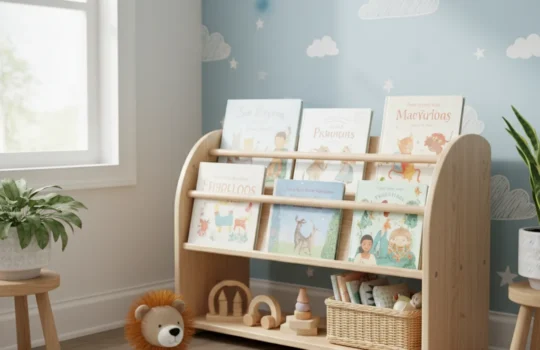
As parents, we often measure the success of a nursery or playroom by how “full” it is. We fill toy boxes with blocks, closets with clothes, and bookshelves with every classic story we can find. However, in our quest to provide abundance, we often overlook a crucial psychological detail: how a child actually sees the world.
If you look at a traditional bookshelf in most homes, you see the spines of books, thin strips of paper with tiny text. For an adult, this is a functional filing system. For a toddler who cannot yet read, it is a wall of abstract patterns that offers no information. Enter the Front-Facing Montessori Bookshelf. This simple shift in design—displaying the cover of the book rather than the spine—is not just an interior design trend; it is a fundamental game-changer for early literacy.
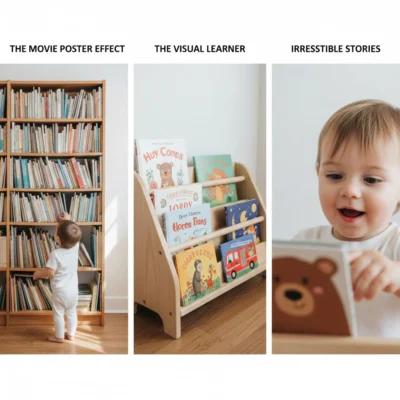
The “Movie Poster” Effect: Engaging the Visual Learner
Children are naturally visual learners. Long before they can decode the alphabet, they are masters at decoding images, colors, and shapes.
When a book is placed on a traditional shelf, its most valuable asset—the cover—is hidden. The cover of a children’s book is designed by world-class illustrators specifically to spark curiosity. It tells a story before the first page is even turned.
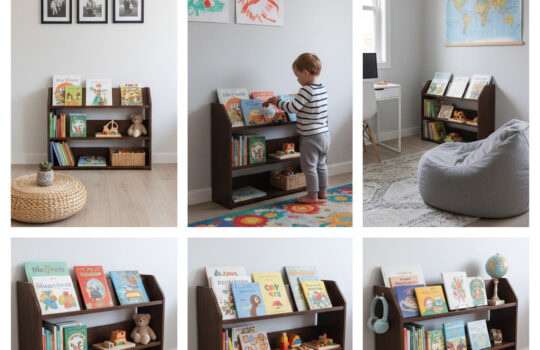
By using a front-facing display, you are essentially creating a “gallery” of stories. Much like a movie poster in a cinema or a featured product in a storefront, the front-facing shelf makes the book irresistible. When a child sees a friendly bear, a bright red tractor, or a shimmering night sky facing them, they don’t need a parent to tell them what the book is about. They are drawn to it instinctively.
Breaking the “Book Avalanche”: Organization with Intention
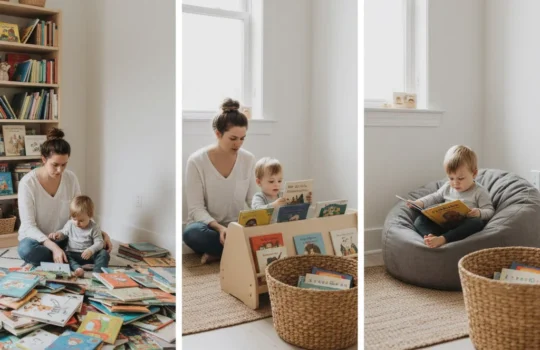
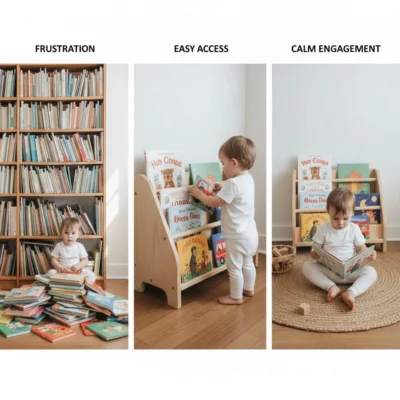
We have all witnessed the “Book Avalanche.” A toddler wants one specific book at the bottom or middle of a tightly packed traditional shelf. They pull, tug, and eventually, thirty books come crashing down onto the floor.
This creates two problems:
-
Frustration: The child is overwhelmed by the mess they’ve made.
-
Disengagement: Instead of reading, the child becomes focused on the chaos or simply walks away.
A front-facing bookshelf solves this by providing clear spatial boundaries. Because books are layered or placed side-by-side with the covers visible, the child can pinpoint exactly which story they want. They can slide it out easily without disturbing the others. This promotes a calm environment where the focus remains on the story, not the struggle of retrieving it.
Empowering Independence: The Montessori Philosophy
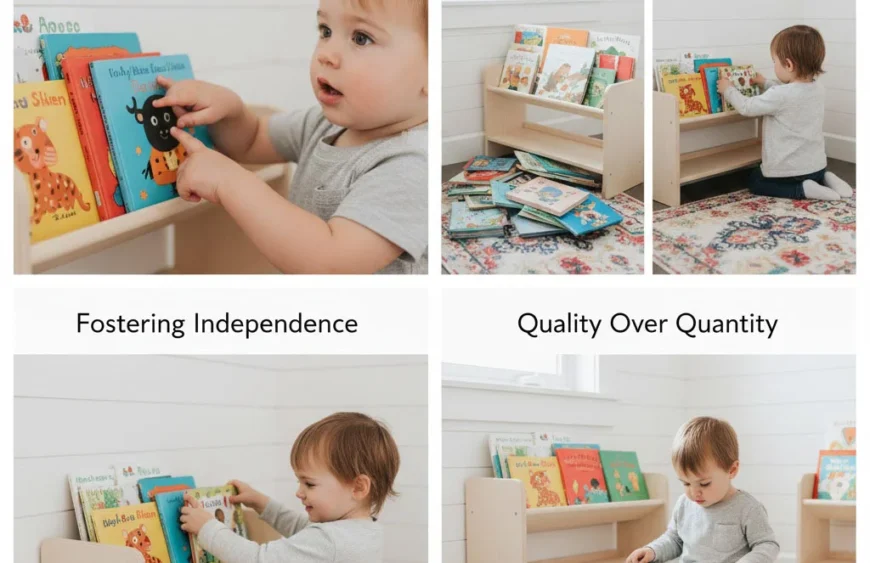
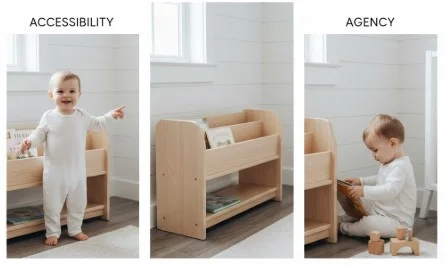
The heart of the Montessori method is the “Prepared Environment.” This means creating a space where a child can function independently without constant adult intervention. A minimalist, low-profile, front-facing shelf is the epitome of a prepared environment.
-
Accessibility: When a shelf is built at the child’s height, it sends a powerful message: “This space is for you.” * Agency: When a child can choose their own book, they are practicing autonomy. They are not a passive recipient of a story chosen by an adult; they are an active participant in their own learning journey.
This independence builds confidence. A child who can navigate their own library at age two is a child who will approach learning with curiosity and self-assurance at age six.
Pre-Reading Skills: Recognizing Context and Narrative
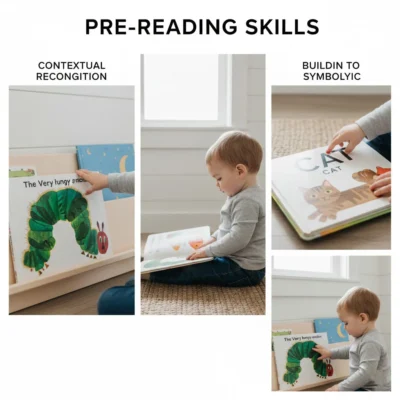
Literacy begins long before a child identifies the letter “A.” It begins with contextual recognition.
When a child looks at a front-facing shelf, they are practicing “reading” the environment. They learn to associate the cover of The Very Hungry Caterpillar with the concepts of food, colors, and transformation. They recognize that the blue book with the moon is for bedtime.
This visual recognition is a precursor to symbolic recognition (reading letters). By seeing the same covers every day in a curated display, the child strengthens their memory and narrative comprehension. They begin to understand that “this image represents this specific world,” which is exactly what happens when they later learn that “this symbol (C-A-T) represents this specific animal.”
Quality Over Quantity: The Art of Curation
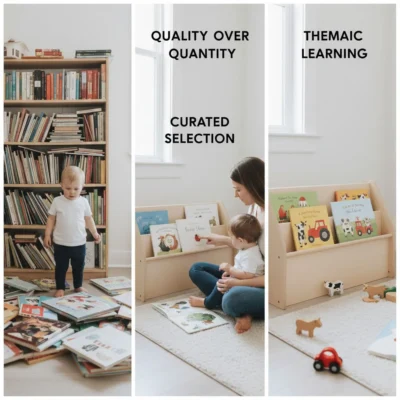
One of the hidden benefits of front-facing bookshelves is that they force us, as parents, to be more intentional. You cannot fit 200 books on a front-facing shelf—and that is a good thing.
In a world of overstimulation, less is truly more. By displaying only 5 to 10 high-quality books, you allow your child to truly “bond” with those stories.
-
Deep Learning: Instead of skimming 20 books, they will dive deep into 5. They will notice the small ladybug hidden in the corner of page three. They will ask questions about why the character is sad.
-
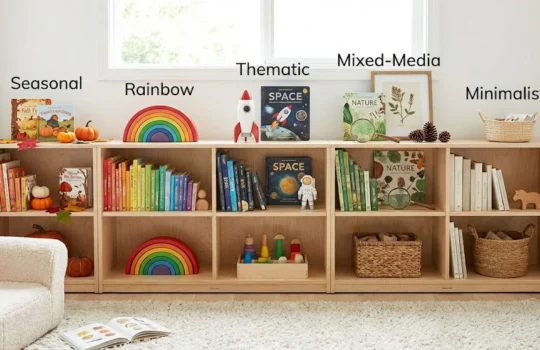
Curated Themes: You can use the shelf to support what they are learning in real life. If you are visiting a farm this weekend, you can fill the shelf with books about cows, tractors, and crops. The bookshelf becomes a dynamic tool that evolves with their life experiences.
The Aesthetic of Calm: Natural Wood and Minimalism
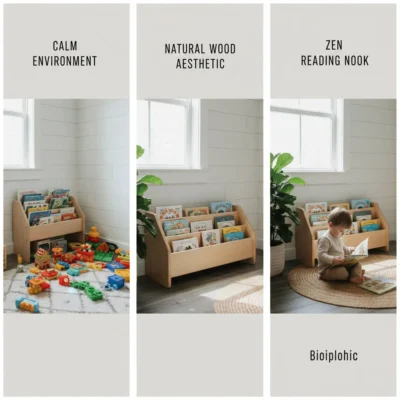
The environment a child grows up in affects their nervous system. Plastic, brightly colored, “busy” furniture can contribute to overstimulation and restlessness. This is why solid wood, minimalist designs are so vital. A natural wood bookshelf provides a neutral, warm backdrop. It doesn’t compete with the books for attention; it highlights them.
The beauty of a handmade wooden shelf lies in its “Biophilic” design—connecting the child to natural materials. It creates a “Zen” reading corner that invites the child to slow down, sit on a rug, and get lost in a page. In a fast-paced digital world, providing a physical, tactile, and beautiful space for books is one of the greatest gifts we can give.
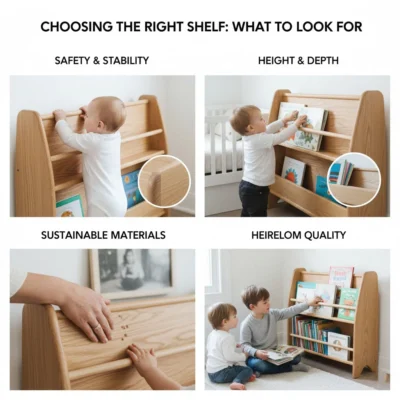
Choosing the Right Shelf: What to Look For
Not all front-facing shelves are created equal. When investing in a piece that will foster your child’s literacy for years, consider these three factors:
- Safety and Stability: For a “cruising” baby or a curious toddler, the shelf will likely be used as a support to stand up. Ensure the shelf is made of solid wood (not flimsy particle board) and has a sturdy base. Rounded edges are a must to prevent injuries during play.
- Height and Depth: The highest shelf should be no higher than the child’s shoulder. If they can’t see the cover of the top book, the “front-facing” benefit is lost. Additionally, look for “slim” designs that don’t take up too much floor space but are deep enough to hold thick board books.
- Sustainable Materials: As a brand focused on handcrafted quality, we believe furniture should be built to last. A solid wood shelf is an eco-friendly choice that avoids the “disposable furniture” cycle. It’s an heirloom that can be passed down, carrying the memories of thousands of bedtime stories within its grain.
More Than Just Furniture
A front-facing bookshelf is an investment in your child’s future. It is a bridge between a pile of paper and a lifetime of imagination. By changing the way we display books, we change the way our children perceive them, not as chores or cluttered objects, but as vibrant, accessible worlds waiting to be explored.
When you provide a child with a beautiful, accessible, and intentional place for their books, you aren’t just decorating a room. You are raising a reader.