
Picture this scenario: You walk into your child’s playroom or nursery. There is a traditional bookshelf stuffed with dozens, perhaps hundreds, of colorful children’s books. Yet, when it’s time to read, your child pulls ten books off the shelf onto the floor, glances at them for three seconds each, and then wanders off to play with something else. The books lie ignored in a messy pile.
As parents, we often think that offering more options leads to more engagement. But in the developing mind of a young child, the opposite is true. Too many choices lead to the “paradox of choice”, a state of overwhelm that results in disengagement and chaos. If you want to foster a deep, lasting love of reading without constant clutter, the solution isn’t buying more books. The solution is Book Rotation.
What is Book Rotation?
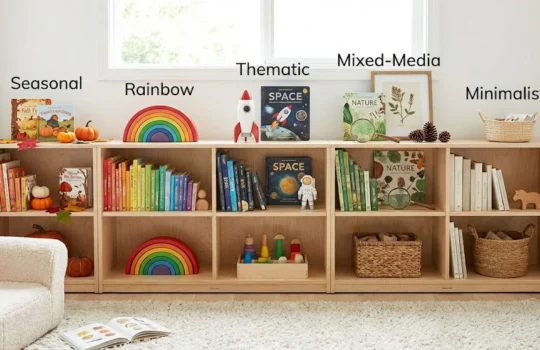
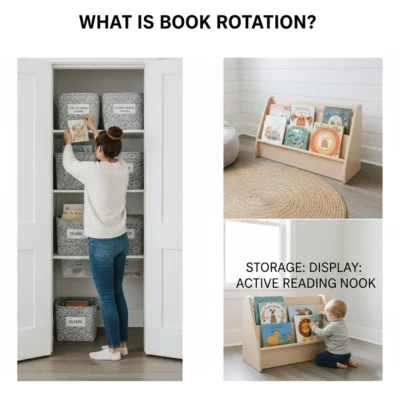
Book rotation is a simple, powerful concept used in Montessori classrooms worldwide. Instead of giving your child access to their entire library all at once, you curate a small, manageable selection of books to display—usually between 5 and 10 at a time. The rest of the collection is packed away, out of sight. Periodically, you swap the books on display with the ones in storage.
It helps to distinguish between two types of book organization:
Storage: The hidden “library” where the bulk of your collection lives (e.g., in a closet or high cabinet).
Display: The active “reading nook” accessible to the child right now.
Why Book Rotation Works (The Benefits)
By embracing the “less is more” philosophy, you aren’t depriving your child; you are enhancing their experience. Here is why it works:
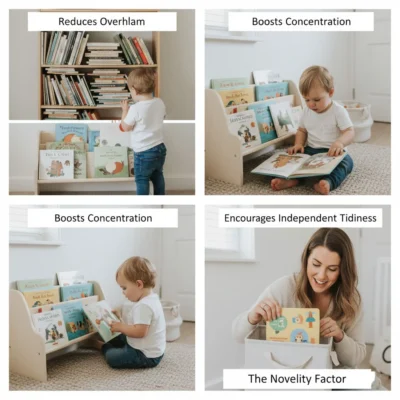
- Reduces Overwhelm and Anxiety: A jam-packed bookshelf is visual noise to a toddler. They don’t know where to look or what to pick. A curated selection of 6 books is inviting and manageable, making it easy for them to make a confident choice.
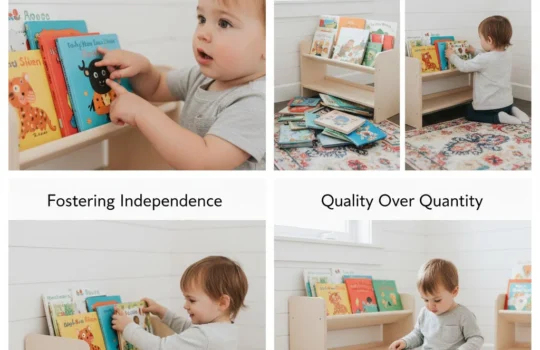
- Boosts Concentration and Deep Reading: When options are limited, children are more likely to return to the same book repeatedly. This repetition is crucial for language development. They begin to memorize the story, understand the narrative structure, and notice new details in the illustrations each time.
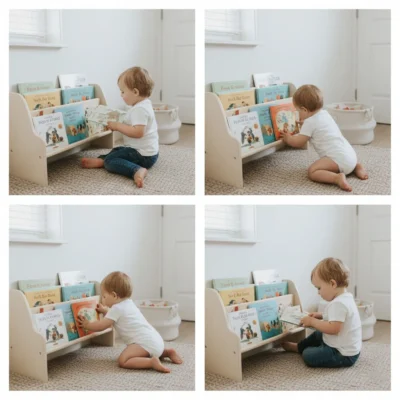
- Encourages Independent Tidiness: Cleaning up 50 books is an impossible task for a three-year-old. Putting 5 books back onto a low shelf? That is an achievable task that builds confidence and responsibility.
- The Novelty Factor: This is the magic trick of rotation. When a book has been hidden away for a month, bringing it back out makes it feel brand new again. You get the excitement of a new toy without spending a dime.
How to Implement Book Rotation in 4 Simple Steps
Step 1: Categorize Your Library
Gather all your children’s books in one spot. Sort them roughly by theme or type (e.g., animals, seasons, vehicles, bedtime stories, emotional learning).
Step 2: Choose Your “Current Favorites”
Select 6–10 books for the first rotation. Try to include a mix of themes, or perhaps focus on a current interest (like dinosaurs) or an upcoming event (like a holiday).
Step 3: Display Front-Facing
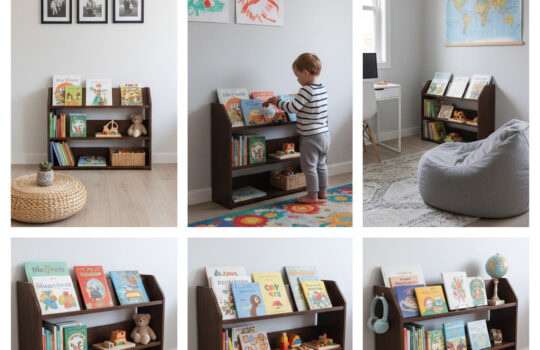
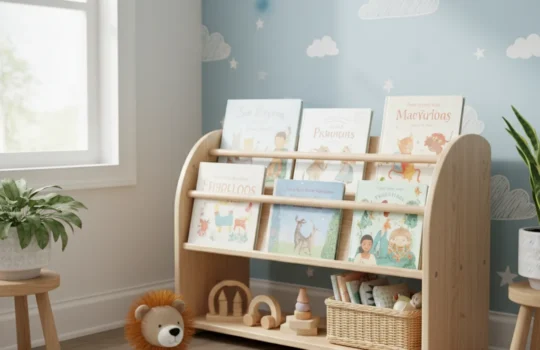
This is crucial. Young children cannot read spines. They choose books based on the cover art. Use a Montessori-style shelf designed to display books cover-forward, inviting the child to pick them up.
Step 4: Store the Rest Out of Sight
Put the remaining books in opaque bins and store them in a closet, garage, or high cabinet. If your child can see them, they will want them all out at once!

The Role of the Minimalist Montessori Shelf
While you can rotate books on any surface, the method works best with the right tool. A Minimalist Montessori Bookshelf is the ideal canvas for book rotation because:
It’s Front-Facing: It turns the book covers into artwork, making the curated selection irresistible.
It’s Accessible: The low profile means even crawling babies can independently select a book and, eventually, learn to put it back.
It’s Nondistracting: A simple wooden design ensures the focus remains on the colorful books, not on the furniture itself.
When Should You Rotate?
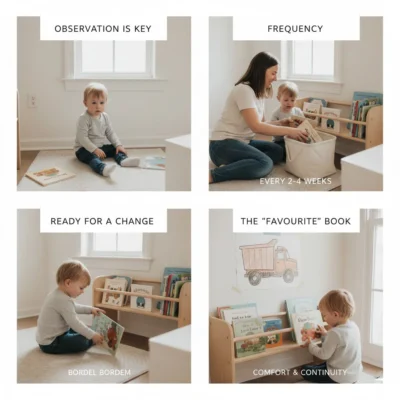
There is no rigid schedule for rotation. In the Montessori method, observation is key. Watch your child. Have they stopped pulling books off the shelf? Are they just throwing them around instead of looking at them? These are signs they are bored with the current selection and ready for a change. For toddlers, this might be every 2 weeks. For older preschoolers, it might be once a month.
Pro-Tip: You don’t have to rotate everything. If your child is obsessed with one specific truck book, keep it out during the next rotation to provide a sense of comfort and continuity.
Less Clutter, More Connection
Book rotation is more than just an organizational hack; it’s a way to respect your child’s developing mind. By clearing the clutter, you make space for focus, imagination, and a genuine love of reading. Remember, the goal isn’t to have the most books; it’s to have the most engaged reader.